
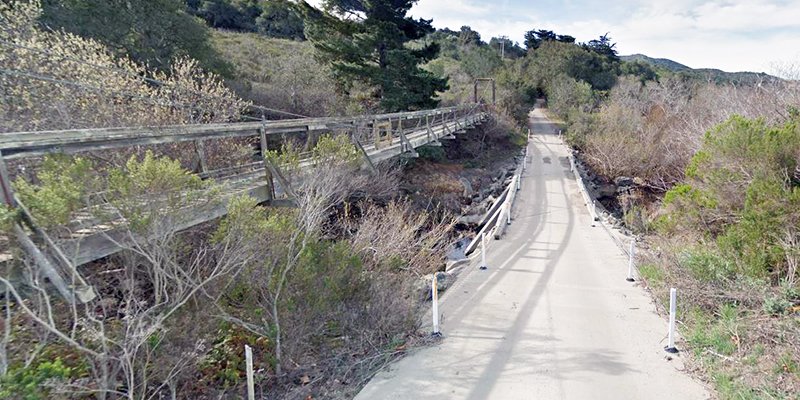
A vehicular bridge and a walk bridge run parallel with each other spanning “Chorro Creek” tributary which travels through San Luis Obispo and Morro Bay, California for drainage into the Morro Bay Estuary then into the Pacific Ocean.
The importance of the walk bridge is readily apparent in the above picture. Cars traveling over the single lane force pedestrians to either jump in the creek, or if the vehicle allows, run to get off the bridge to allow the vehicle to pass.
Honestly, with great care a compact or sub-compact car will allow enough space for a pedestrian to pass, but if it’s a truck… forget about it. And, if pedestrians attempt to cross the bridge at night with no lighting, the danger rises dramatically. This is but one of the reasons why the walk bridge is important even when it’s not raining.
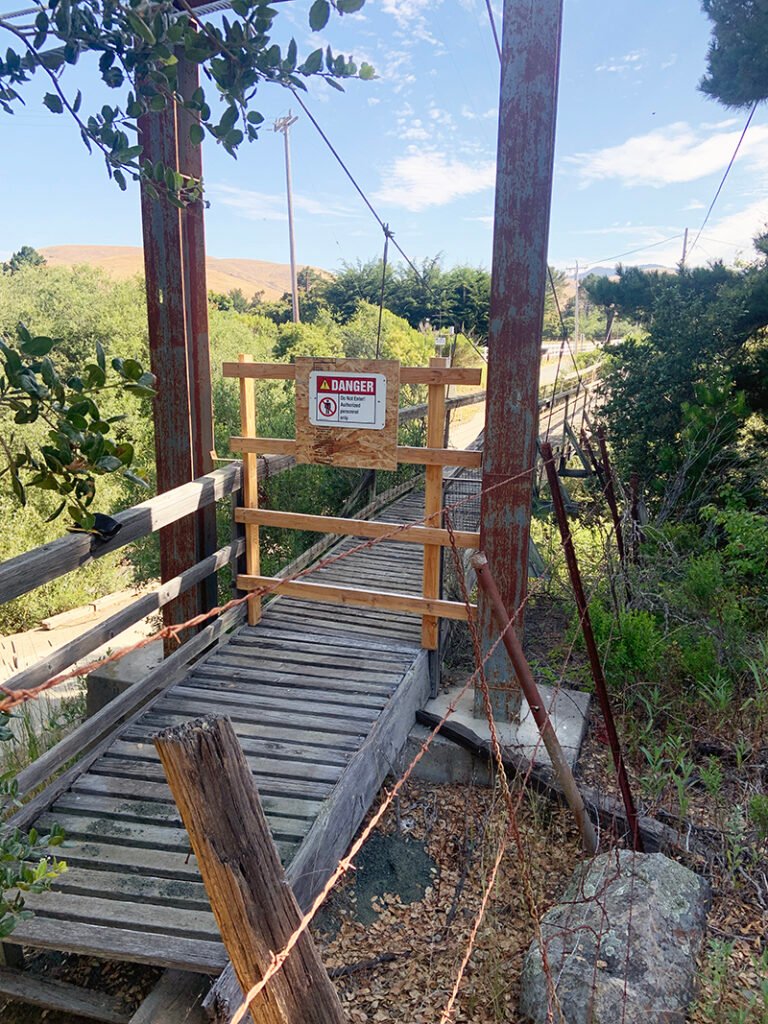
The City of Morro Bay, California installed a walk-bridge in the 1970s, and over the years has failed to properly maintain the bridge. When people began falling through the bridge because the planks were so terribly rotted, the City of Morro Bay decided to immediately close it down and schedule it for destruction.
One of the residents in the area said she has lived their for fifty-three (53) years and her grandparents before her lived their long before she did.
She said if her memory serves, the City of Morro Bay, California built the walk bridge outside their city limits to help service and maintain a potable water pumping station located in San Luis Obispo County.
The vehicular bridge is another story. She believes the vehicular bridge was built by the County of San Luis Obispo but with State allotted funds. After interviewing several of the locals, a picture is starting to emerge about how both the walk bridge and vehicular bridge came to be.
It’s still sketchy, but we are slowly getting closer to understanding how both bridges originated.
Upon hearing of Morro Bay’s secret plan to destroy the walk bridge, the residents and general public who have been using the walk-bridge for fifty (50+) years decided to push back. They asked the obvious question, “Why was there no hearing or requested feedback from the public?”
The purpose of this website is to provide information to all the residents who rely on the walk-bridge, as well as the general public who have enjoyed the walk-bridge for five decades. Sometimes people have to join together to fight “city hall” or end up losing their freedoms. This appears to be one of those occasions.
UP SHIT’S CREEK
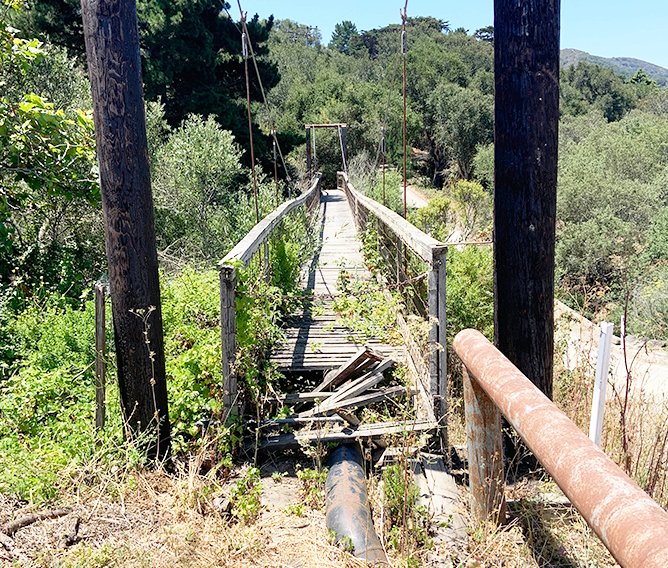
Many years ago, we are still trying to nail down exactly when the walk-bridge bridge was constructed over Chorro Creek adjacent to the Canet Road vehicular bridge.
Chorro Creek begins behind the prison approximately eight miles inland.
It meanders through the countryside arriving at the Morro Bay Estuary before entering the Pacific Ocean approximately 3-4 miles away from the walk and vehicular bridges.
“Chorro” is a word that Mexican people used as a synonym for “diarrhea.”
Whether the locals know it or not, they are living near a tributary that, at one time, sent raw sewage into the Pacific Ocean. A hundred years ago, that’s the way it was done.
So that’s the setting… the cars and people used to travel over the creek bed through raw sewage in order to get to the other side.
When the rainy season arrived making travel over the creek bed impossible, everyone who wanted to cross were out of luck.
Eventually, the City of Morro Bay, California installed a walk bridge to allow their engineers and maintenance personnel access to there potable water dumping station on the other side of Chorro Creek.
WALK BRIDGE WAS BUILT
DECADES BEFORE THE VEHICULAR BRIDGE
As best we can tell, the walk-bridge was installed in the mid 1970s. Driving through polluted water was one thing, but walking through it was another. This is why the walk bridge was built before the vehicular bridge.
The walk bridge was erected over a large water pipe that supplied well-water to the residents of Morro Bay, California. Without this water pipe, many residents and businesses in Morro Bay would not have access to potable water.
Residents on the other side of the creek also used the walk-bridge when the weather prevented their vehicles from crossing. The walk bridge was a God-send, because without it there would be no way to get home until the creek levels subsided.
Jose Canet 1841-1888, settled the area more than a century ago after receiving his Spanish land grant. One of the local residents said her father’s side of the family owned the land for 150 years. She also said that before Morro Bay erected the present walk bridge there was a suspension walk bridge over the creek for twenty years before that.
The growing numbers inhabitants in the area brought with it a demand for potable water and created a sewage problem as well.
To solve the problem of dumping raw sewage into the Pacific Ocean, a sewage treatment plant was erected up stream. The treatment facility greatly diminished water pollution allowing Chorro Creek to slowly come back to life.
Residents say that as they walked over the walk-bridge they could easily see steelhead fish and many turtles and frogs amongst other wildlife.
At some point, the County of San Luis Obispo realized that having cars driving through Chorro Creek was not a good idea so they decided to build a vehicular bridge.
We’re not sure how all the politics played out, but it could be San Luis Obispo County was ordered to rectify the problem by the California Coastal Commission who has jurisdiction several miles inland over tributaries emptying into the Pacific Ocean.
At about the same time the City of Morro Bay was constructing the walk bridge over Chorro Creek in 1972, California citizens were alarmed that private development was cutting off public access to the shore. They started an organization called, “Save Our Coast.”
The “Save Our Coast” initiative declared that “it is the policy of the State to preserve, protect, and where possible, restore the resources of the coastal zone for the enjoyment of the current and succeeding generations.”
Proposition 20 was put on the ballot, which ultimately led to the passage of the Coastal Act and the establishment of the California Coastal Commission. Over time, their power has grown dramatically to protect California’s 840 miles of coastline from Mexico to Oregon.
Canet Rd. (just off Highway 1) went from an old dirt farming road to a paved rural road crossing Chorro Creek. Highway 1 is the main connection between Morro Bay and San Luis Obispo, California.
In 2001, a new concrete vehicular bridge on Canet Road was completed which runs parallel to the walk bridge over Chorro Creek.
Things were better, but travelers soon discovered the engineers had constructed the new bridge at a lower height than it should have been. Every year, the vehicular bridge floods out multiple times forcing residents to use the walk bridge in order to get to/from their homes.
When rain arrives every year, the concrete vehicular bridge will become submerged forcing people to park their cars and utilize the walk-bridge.
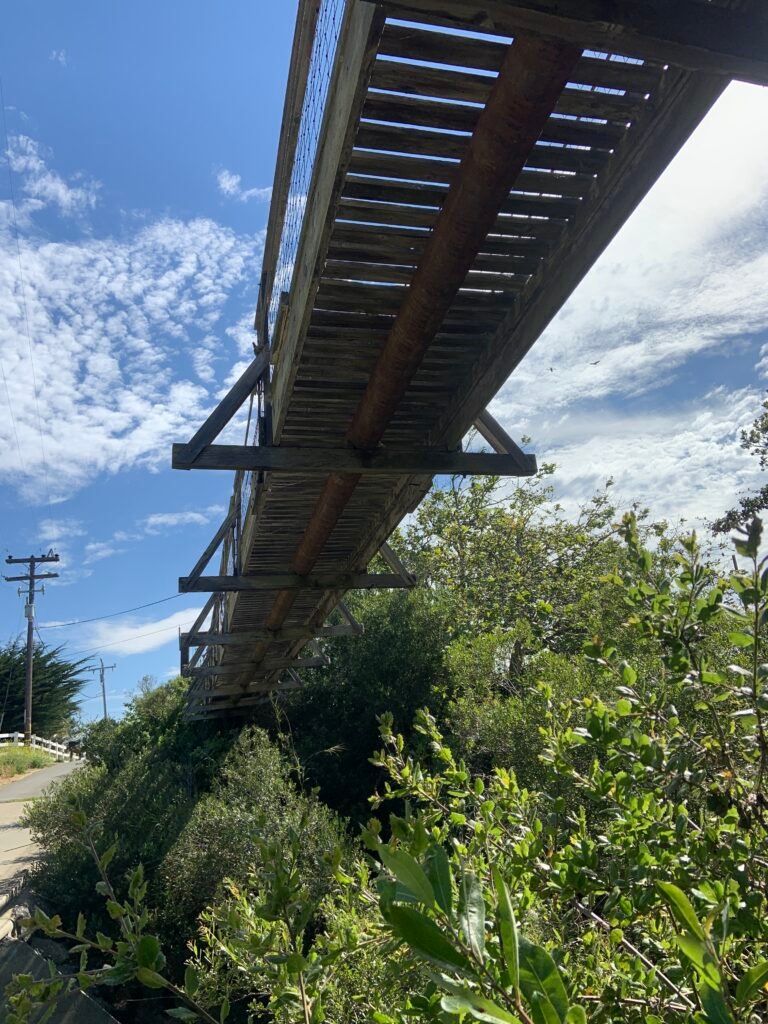
For nearly fifty (50) years, the residents (and city officials of Morro Bay) have used the walk bridge when the vehicular bridge became impassable.
This was standard operating procedure until the walk-bridge became to dangerous to even stand on.
Bridge flooding generally dissipated in 5-10 hours allowing cars to once again travel over the bridge, but frequently there were times when the vehicular bridge becomes impassable for 2-3 days.
This is why the walk-bridge is so vitally important for the residents who have no other way in or out.
So, what’s an paramedic crew supposed to do now to help a senior on the other side of the creek when it rains?
THE POORLY DESIGNED VEHICULAR BRIDGE
FORCES PEOPLE TO USE THE WALK-BRIDGE
The engineers who designed the vehicular bridge did so apparently with faulty weather data, which is why the vehicular bridge is so much lower than the walk-bridge.
Engineers designed the vehicular bridge at a much lower elevation because they mistakenly believed the bridge would only become impassable by storm surge flooding once every seventy (70) years.
Boy were they wrong!
Chorro Creek becomes impassable about 3-4 times per year forcing residents to use the walk-bridge to get home and allowing Morro Bay officials access to service and maintain their well pumping station.
Believing the bridge would only flood once ever 70 years led to the poor design of the vehicular bridge. This poor design causes chronic flooding each and every year.
The flooding becomes a serious hazard to vehicular traffic when people attempt to cross while water is spilling over the top of the bridge. Vehicles have gone over the side and down the creek.
If the vehicular bridge had been constructed properly, it logically would have been installed at the same height as the walk-bridge. If the vehicular bridge had been designed at the proper height with two lanes and a pedestrian walkway, there would be no need for a walk-bridge.
Instead, the vehicular bridge only has one lane and no space for pedestrians to safely traverse the bridge, even during good weather. Presently, a high level of danger exists for anyone who walks over the vehicular bridge regardless of the weather, and especially at night.
We dare city and county officials to take a walk with us at night over the vehicular bridge to see for themselves the extraordinary danger it poses.
THE CRUX OF THE PROBLEM
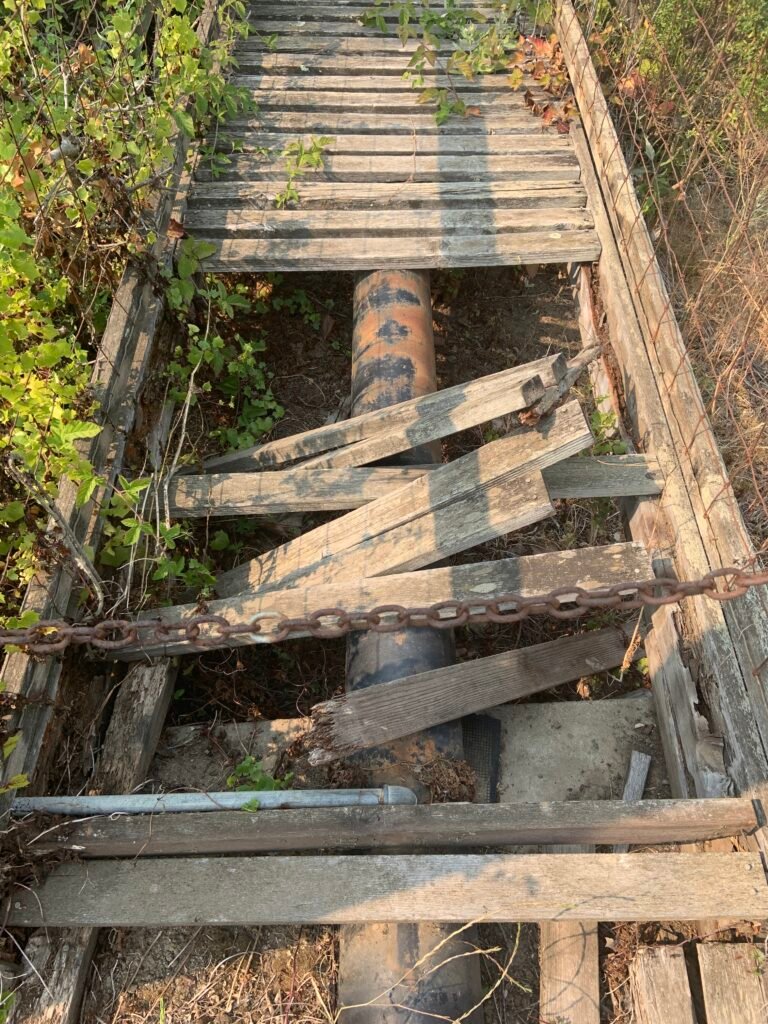
The City of Morro Bay has become derelict in their duty to properly maintain the walk-bridge placing the lives of residents and the general public in danger.
They know that now and that’s why they have decided to destroy the walk-bridge.
When people began falling through the walk-bridge because the planks were rotted so badly, Morro Bay City officials decided to just board up the bridge until they could marshal their demolition crew.
County and city administrators are darn lucky that someone did not fall through the center of the bridge. The fall would have seriously injured or even killed the unfortunate pedestrian.
One of the residents sent a letter to Morro Bay officials dated July 17,2023, requesting a meeting to sit down and discuss the issue of the walk-bridge. There was no response until November.
On November 6, 2023, the Director of Public Works for the City of Morro Bay, California disclosed the city’s plan to destroy and remove the walk-bridge instead of repair and maintain it.
The destruction of the bridge would be initiated in a matter of days. By moving rapidly to destroy the walk-bridge, the City of Morro Bay hoped to put this issue to rest and quickly as possible.
After fifty (50) years of use by the residents and the general public, the City of Morro Bay unilaterally decided to destroy the walk-bridge without a hearing or public feedback of any kind.
City officials decided on their own to destroy the bridge which the residents and general public have been using for literally five decades.
Destroying the walk-bridge only makes the situation worse. Doing so, places more lives in danger by forcing pedestrians to use the vehicular bridge that was not designed for pedestrian traffic.
WHAT HAPPENS NEXT?
Obviously, the residents and other citizens who enjoyed the use of the walk-bridge have voiced their understandable displeasure. They decided to get organized pushing back against Morro Bay City officials.
They hope to “encourage” Morro Bay to scrap their idea of dismantling the bridge. Instead, they need to bring it back to life for the enjoyment and use by all residents and citizens who desire to do so.
Why don’t Morro Bay inspectors still need access to their well and pumping station as they did in the past? That was the primary reason for erecting the walk-bridge in the first place.
As much as no one wants to do it, lawyers will have to become involved. The City of Morro Bay is hellbent on destroying the walk-bridge forcing pedestrians to walk over the vehicular bridge.
This is a very stupid idea. If anyone gets hurt or killed walking over the vehicular bridge, the City of Morro Bay must shoulder some (if not all) of that responsibility.
The residents have decided to seek legal counsel to see if they have legal standing to obtain injunctive relief until a hearing can be convened and a judge can render a decision on the matter.
Not only does the walk-bridge keep people safer during inclement weather, it also keeps people safe during the dry summer months by encouraging them not to use the vehicular bridge to get to the other side.
It all boils down to money. The City of Morro Bay would rather destroy the walk-bridge rather than pay the cost to maintain it.
The City of Morro Bay, like any municipality, is concerned about liability. Given the fact the walk bridge has been used for 50+ years, why are they suddenly concerned about liability now? It didn’t seem to bother them 50 years ago.
They should have thought about liability and maintenance costs when the bridge was erected decades ago.
Up until recently, local residents and the general public have had open and notorious use of the bridge for over a half-century. It wasn’t until people started falling through the walk bridge that Morro Bay decided to destroy the bridge rather than fix it.
If Morro Bay is determined to destroy the walk-bridge, the vehicular bridge should also be destroyed, then replaced with a much better design.
A new vehicular bridge could be erected at a proper height over Chorro Creek to safely handle both pedestrian and vehicular traffic year round, but especially during storm events which causes a docile tributary to suddenly swell into a raging river for hours and days at a time.
Whoops, now we are venturing into multi-jurisdictional problems since the county installed the vehicular bridge and Morro Bay who installed the walk-bridge. Again, don’t we need a public hearing on the matter?
If you’re interested in supporting efforts to prevent the City of Morro Bay from destroying the walk-bridge, please go to our contact page and let us know.
Your support, is deeply appreciated by everyone who uses the bridge, and especially all those who need the bridge when the Gales of November come calling.